
Updated June 1st
The Science Based Targets initiative (SBTi) is undertaking a major revision of its Corporate Net Zero Standard. With many companies struggling to meet their long-term climate goals, the SBTi is zeroing in on the biggest hurdle of all by completely revamping how we approach Scope 3 emissions. This guide explores the five main challenges of value chain reporting and breaks down the SBTi's latest proposals to make Scope 3 decarbonization more actionable and realistic.
Why the Corporate Net Zero Standard Needs a Major Update
The Science Based Targets initiative (SBTi) is undertaking a major revision of its Corporate Net Zero Standard. The standard was released in October 2021 to provide “a clear, consistent and science-based definition of net zero”, helping companies to set net zero targets aligned with limiting global warming to 1.5C. (Even if this goal is looking increasingly forlorn…)
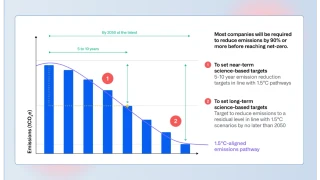
The net zero standard can be thought of as the long-term counterpart to near-term Science-Based Targets (SBTs). Firms that set near-term SBTs commit to reduce their emissions over a five-to-ten year period (typically by around 42% over ten years). Companies committing to net zero targets additionally undertake to reduce emissions by around 90% by 2050. Near-term SBTs are the waypoints to achieving net zero.
So far around 1,300 companies have set SBTi approved net zero targets (a further 2,500 have committed to do so). But this represents only about one-fifth of the firms that have set near-term SBTs. Moreover, the SBTi has removed net zero commitments from 570 or so companies that failed to submit targets within the two-year deadline.
After initial enthusiasm, many companies have become wary of publicly committing to long-term net zero goals. The likelihood of achieving far-off targets is uncertain and often dependent on unproven, costly technology or supportive policy, which raises risks of greenwashing.
The biggest barrier that companies face is the challenge presented by scope 3. The SBTi requires companies to include 90% of their scope 3 emissions within their net zero target. On the way to net zero, most firms are required to set near-term SBTs covering at least 67% of scope 3 emissions sources.
Why Scope 3 Emissions Remain the Biggest Challenge
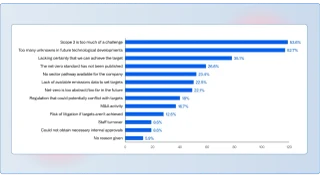
The SBTi has made addressing scope 3 a core focus of its revision of the corporate net zero standard. This summer the organisation released a discussion paper providing a diagnosis of key challenges and potential solutions. These include five main challenges:
1. Measuring scope 3 - it’s tricky and imprecise
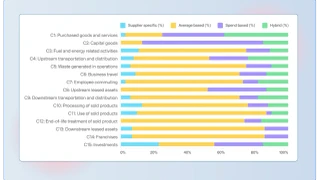
Firms struggle to access quality primary data, leading to a reliance on broad-brush spend-based and average estimates. The lack of prescriptiveness in GHG Protocol standards allows for variability in methodologies and assumptions, which undermines comparability and trust.
2. Making sense of scope 3 - it’s hard to interpret
Scope 3 is an aggregate of emissions that have already happened (e.g. procurement) and will happen (e.g. use of a product/service and disposal). It tends to be volatile since a company’s scope 3 emissions depend not only on the emissions intensity of the activity but also how much it’s buying, selling or investing in that activity. It can be hard to make sense of an aggregate.
3. Setting scope 3 targets - it’s loosely defined
Under current rules companies have complete flexibility on which sources to include in their near-term scope 3 target - provided they cover the 67% threshold. The concern is that material sources may be omitted in favour of those that are easier to measure but less material (such as business travel).
4. Reducing scope 3 - it’s difficult to influence
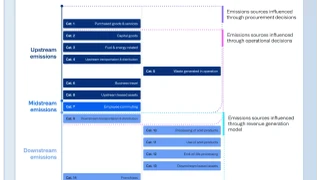
Indeed, a company’s ability to influence certain scope 3 emissions may not be very correlated with their overall significance. Influence depends on the type of relationship a company has with the emissions source (whether it’s upstream or downstream, one-to-many or many-to-one), its degree of market power, and the technical feasibility of decarbonisation for that activity.
5. Making progress - it's hard to track
As a result of the above challenges, it can be hard for companies to demonstrate progress. The right interventions can be difficult to identify, slow to take effect, and may be obfuscated by imprecise measurements, volatility, and creative accounting. Teams can track scope 3 progress against a target you can defend by holding a consistent baseline and recording each intervention alongside the emissions it is meant to move.
Three Proposals to Overhaul Scope 3 Target Setting
To address some of these challenges the SBTi set out three main proposals.
Proposal 1: Measuring outcomes
The SBTi is proposing to introduce outcome-based metrics, which would complement emissions data. The objective is to have a more immediate way to capture the outcomes of a company’s scope 3 interventions, which should eventually lead to a reduction in emissions. These metrics should enable early signs of progress to be measured, tracked, and adjusted.
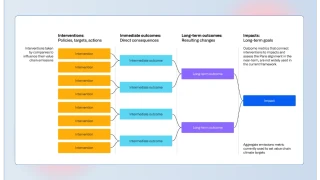
There is already precedent for this. The SBTi gives companies the option to set scope 3 engagement targets. Instead of targeting a specific reduction in emissions, companies commit to persuading a specific proportion of their suppliers or customers to set SBTs. Similarly, for scope 2, companies can commit to achieving a certain percentage of renewable energy procurement.
Under the proposals, the SBTi would set alignment targets, which would require companies to achieve specified outcomes in their upstream procurement and downstream revenues - aligned to net zero goals. For example, companies would need to purchase or sell a certain share of zero or low-carbon materials, use a specific share of zero or low-carbon business travel, and so on.
Proposal 2: Prioritising climate-relevant activities
The SBTi is also proposing a more strategic approach to emissions reductions by focusing target boundaries on the most climate-relevant emissions sources.
This would mean drilling down beneath the scope 3 categories to individual activities to identify and target those that are most emissions intensive and/or that relate to high climate impact sectors (e.g. high energy or land-use-intensive sectors).
For example, disaggregating the Scope 3 business travel category into its component activities like flights, trains, buses, cars, etc and focusing on flights. Having a high-quality inventory is a critical precursor to achieving this level of disaggregation.
Proposal 3: Accounting for influence
The SBTi is also looking at ways that influence could be more explicitly taken into account when organising decarbonisation efforts:
- One option under consideration would be for companies to prioritise their interventions and targets on the emissions sources that they can influence - potentially excluding emissions over which they have little or no influence.
- An alternative approach would be to require companies to make specific interventions to address emissions sources over which they are deemed to have influence.
Both approaches have their drawbacks and the SBTi is yet to recommend one or the other.
What These SBTi Updates Mean for Your Carbon Strategy
The main message here is the need to focus on what matters. Companies need to develop high resolution footprints. It’s not sufficient to know where your emissions hotspots are. Firms must be able to pinpoint specific assets, activities, and sites that require attention. Only by doing so, will they be able to identify precise interventions that can have meaningful influence.
The SBTi’s proposals also underline that the value of a carbon inventory isn’t only in the emissions. The process of capturing and structuring activity data on energy usage, transport patterns, water, waste, procurement, etc. provides companies with a treasure trove of valuable data that can be used to inform action - as the SBTi proposes with its outcome-based metrics.
For now, these are only proposals. The SBTi is set to release a draft of a new corporate net zero standard for consultation early next year. A final version is due at the end of 2025.